

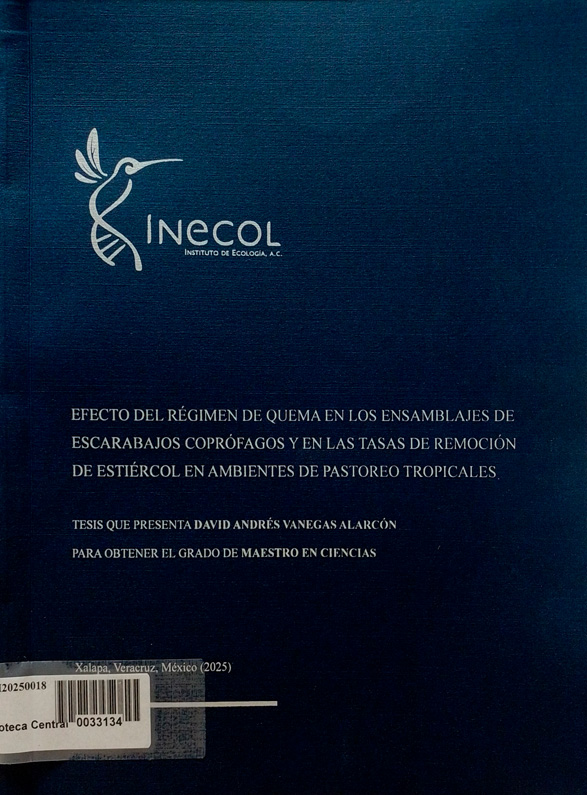
Efecto del régimen de quema en los ensamblajes de escarabajos coprófagos y en las tasas de remoción de estiércol en ambientes de pastoreo tropicales.
Presenta: Vanegas Alarcón, David Andrés
Grado: Maestría en Ciencias
Instituto de Ecología, A.C., 2025
Dirección de tesis: Dra. Lucrecia Arellano Gámez
The burning regime, in terms of intensity, frequency and magnitude, plays a key role in the maintenance of biological diversity. However, this can negatively affect insect diversity. In this study, we analyzed how the burning regimes in terms of intensity, frequency and magnitude affect species diversity, functional groups, and dung removal by dung beetles in grazing environments in a dry forest landscape. Although the burning regime did not influence the number of individuals or the species richness, diversity and dung removal by dung beetles, it did influence the species composition of dung beetles. The assemblage of dung beetles was different in grazing environments with low or high burning regimes. In functional terms, a negative effect of burning regimes on tunneler and necrophagous beetles was observed. However, other functional groups did not show any influence of the burning regime, remaining stable. These results may be due to changes in food availability and the replacement of dung beetle species coming from nearby sites. These factors influence the structure, composition and stability of dung beetle diversity, which could be crucial for the resilience of the studied grazing environments. It is important to note that the timing of burning on grazing environments as well as adaptations of dung beetles are key factors for their survival in grazing environments affected by fire.
Consulta esta tesis en la clasificación: TMM20250018
Forma sugerida para citar
- Vanegas Alarcón, David Andrés. (2025). Efecto del régimen de quema en los ensamblajes de escarabajos coprófagos y en las tasas de remoción de estiércol en ambientes de pastoreo tropicales [Tesis de maestría]. Instituto de Ecología, A.C.
